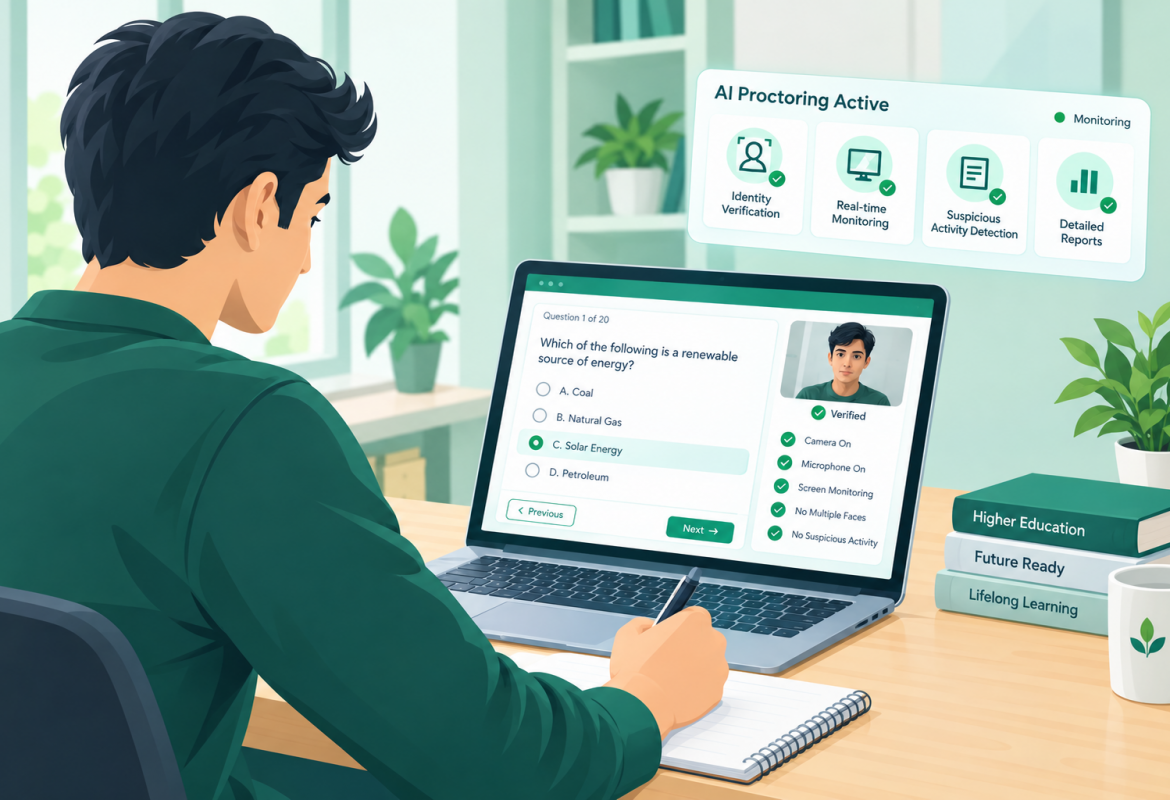
Online examinations have opened up flexible learning for lakhs of students across India — but they’ve also created a genuine problem for colleges and universities: how do you make sure an exam taken from a student’s bedroom is as fair and secure as one taken in a supervised hall?
That’s exactly the gap online exam proctoring is designed to close.
For institutions running UGC-recognised online or distance-learning programmes, this isn’t just a “nice to have” feature — it ties directly into regulatory expectations around examination integrity, transparency, and credibility. This article breaks down what UGC actually says about proctored examinations, why it matters, and what a good proctoring setup should include.
What Is Online Exam Proctoring?
Online exam proctoring is the process of supervising a student while they take a remote exam — using a mix of technology and, in some cases, human oversight — to confirm their identity and keep the testing environment fair.
Depending on the system used, this can involve:
- Verifying the candidate’s identity before the exam starts
- Live or recorded webcam monitoring
- Face detection to confirm the same person stays in frame
- Audio monitoring for background conversations
- Alerts for multiple faces appearing on camera
- Tracking tab switches or screen activity
- Flagging unusual objects (like phones) in the camera view
- Time-stamped logs of anything unusual
- A downloadable report once the exam is over
None of this is about assuming every student is trying to cheat. A well-built proctoring system simply flags anything worth a second look, so the institution can decide what to do with that information.
What Does UGC Actually Say About Proctored Exams?
If your institution runs online or Open and Distance Learning (ODL) programmes, UGC’s regulatory framework is the reference point that matters here.
Does UGC require proctored examinations for online programmes?
Yes. UGC’s regulations for online programmes state that examinations must be conducted in proctored mode, in line with the norms the Commission has laid out. The regulations describe a proctored exam as one conducted under the supervision of an approved person, or through technology that can confirm the test-taker’s identity and protect the integrity of the exam environment.
UGC’s Distance Education Bureau reiterates this too — examinations for approved online programmes need to happen in proctored mode, following applicable Commission norms.
What does this actually mean day-to-day for an institution?
In practice, it means proctoring shouldn’t be treated as a bolt-on anti-cheating tool. It needs to be part of how the entire examination process is designed — covering identity verification, monitoring, incident logging, review, and record-keeping.
Why Proctoring Matters for Higher-Education Institutions
1. It protects exam integrity
A physical exam hall has natural checks built in — invigilators, seating arrangements, no phones. Remote exams strip most of that away. A student could have notes nearby, get help from someone in the room, or switch to another tab mid-test. Proctoring software exists to catch and log that kind of activity so it can be reviewed properly.
2. It verifies who’s actually taking the exam
For institutions running exams across a large, spread-out student base, confirming that the person on camera is the registered candidate — and stays that way throughout — is one of the most basic requirements of a credible exam.
3. It creates a record you can actually review
Instead of relying on a proctor’s memory or a scribbled note, digital proctoring gives you structured records: candidate details, timestamps, flagged events, screenshots where relevant, and the outcome of any review. That’s a much stronger foundation if an exam attempt is ever questioned or audited.
4. It supports the transparency UGC expects
UGC’s guidelines emphasize security, transparency, and credibility for online programme examinations. A proctoring system that generates clear, reviewable records helps institutions demonstrate exactly that — not just to regulators, but internally, for their own quality processes.
What Should Institutions Look for in a Proctoring System?
Not all proctoring tools are built the same way. Here’s what actually matters when evaluating one:
- Identity verification — a dependable way to confirm who’s sitting the exam before it even begins.
- Continuous monitoring — checking in once at login isn’t enough; monitoring should run through the exam where the exam format calls for it.
- Automated violation detection — AI flagging things like multiple faces, unusual audio, tab switches, or restricted objects — treated as flags for review, not automatic guilt.
- Detailed, exportable reporting — administrators need to be able to pull up what happened, when, and why it was flagged, without digging through raw footage.
- Scalability — a system that works fine for 50 students in a pilot batch needs to still work for 5,000 during a semester exam, without needing five times the manual effort.
Institutions creating exams through a paper generatorshould apply the same level of attention to how those exams are securely conducted and monitored — exam creation and exam security work best when they’re part of the same workflow.
Why Proctoring Reports Matter More Than People Realize
The monitoring itself is only half the value — the other half is what you can do with the data afterward.
If an exam attempt gets flagged, a good report gives your examination team everything in one place: timestamps, the specific event that triggered the flag, candidate details, and any supporting evidence. That turns what could be a messy dispute into a straightforward review.
These reports can also be linked back to records in your institution’sstudent/class management software, keeping academic and disciplinary history in one place rather than scattered across separate systems.
The flow looks something like this:Exam → Monitoring → Violation Detection → Human Review → Report → Record-Keeping
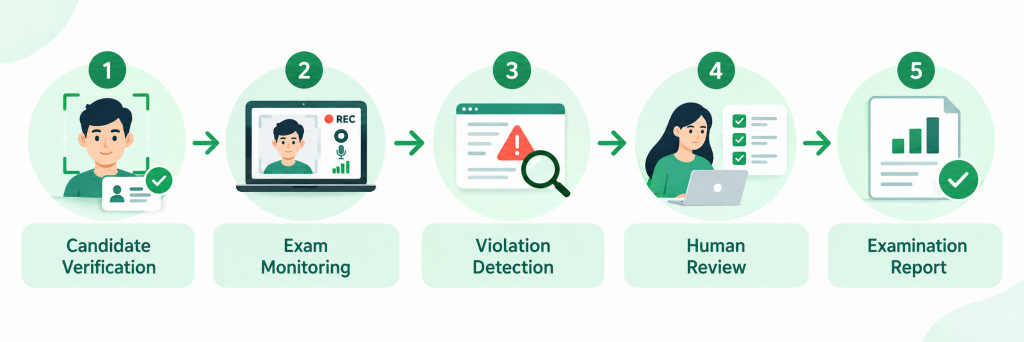
This matters for more than just catching cheating — it’s genuinely useful for internal audits, quality reviews, and keeping documentation in order, based on each institution’s own policies.
How MyClassAdmin Approaches Online Exam Proctoring
MyClassAdmin’s AI Proctoring software brings identity verification, live monitoring, and violation detection together with reporting that’s actually usable by administrators — not just IT teams.
It covers face and voice verification, gaze tracking, multiple-face detection, audio anomaly alerts, object detection, and tab-switch monitoring. On the admin side, you can review a full violation timeline, check webcam snapshots, leave remarks, set your own violation thresholds, and export everything for record-keeping.
The point isn’t just to catch violations — it’s to make the entire exam-to-report process something your team can actually manage without extra manual work.
Frequently Asked Questions
Does UGC require proctored examinations for online programmes?
Yes — UGC’s regulations state that examinations for online programmes must be conducted in proctored mode, following applicable Commission norms. Institutions should always check the current regulations for their specific programme type.
What’s the actual purpose of online exam proctoring?
To verify candidate identity, monitor exam activity, flag potential violations, and create a reviewable record — helping maintain exam integrity for remote assessments.
Does an AI proctoring alert automatically mean a student cheated?
No. A flag simply means an event needs a closer look. Institutions should apply their own review process and judgment before deciding whether something counts as misconduct.
What should a proctoring report include?
Typically: candidate details, exam information, timestamps, flagged events, supporting evidence like screenshots, reviewer remarks, and the final outcome.
Is proctoring only relevant for universities?
Not at all. Colleges, coaching institutes, competitive exam centres, and even recruitment teams running remote assessments can all benefit from the same core capabilities.
In Summary
Online exam proctoring isn’t just about catching students who might cheat — it’s about building an exam process that’s fair, verifiable, and transparent from start to finish.
For UGC-regulated online programmes, that means treating proctoring as part of the exam infrastructure itself: verifying who’s taking the test, monitoring it properly, logging anything unusual, and keeping records that hold up to scrutiny.
Institutions evaluating proctoring solutions should look past flashy AI features and focus on the full picture — identity checks, monitoring quality, review workflows, and reporting that their own team can actually use.
About MyClassAdmin
MyClassAdmin is a School and Coaching Institute Management Software built for educational institutions across India. From student attendance and fee management to homework, report cards, and parent communication, it brings the everyday administrative work of schools and coaching centres into one connected platform, helping administrators and teachers spend less time on paperwork and more time on students.
Sales Enquiries: Vidya — +91-9503273330
Technical Support: 91-7775048333 | mailto: mailto:info@myclassadmin.com
Want to see how digital attendance works in your school?
Visit MyClassAdmin and experience hassle-free attendance management.